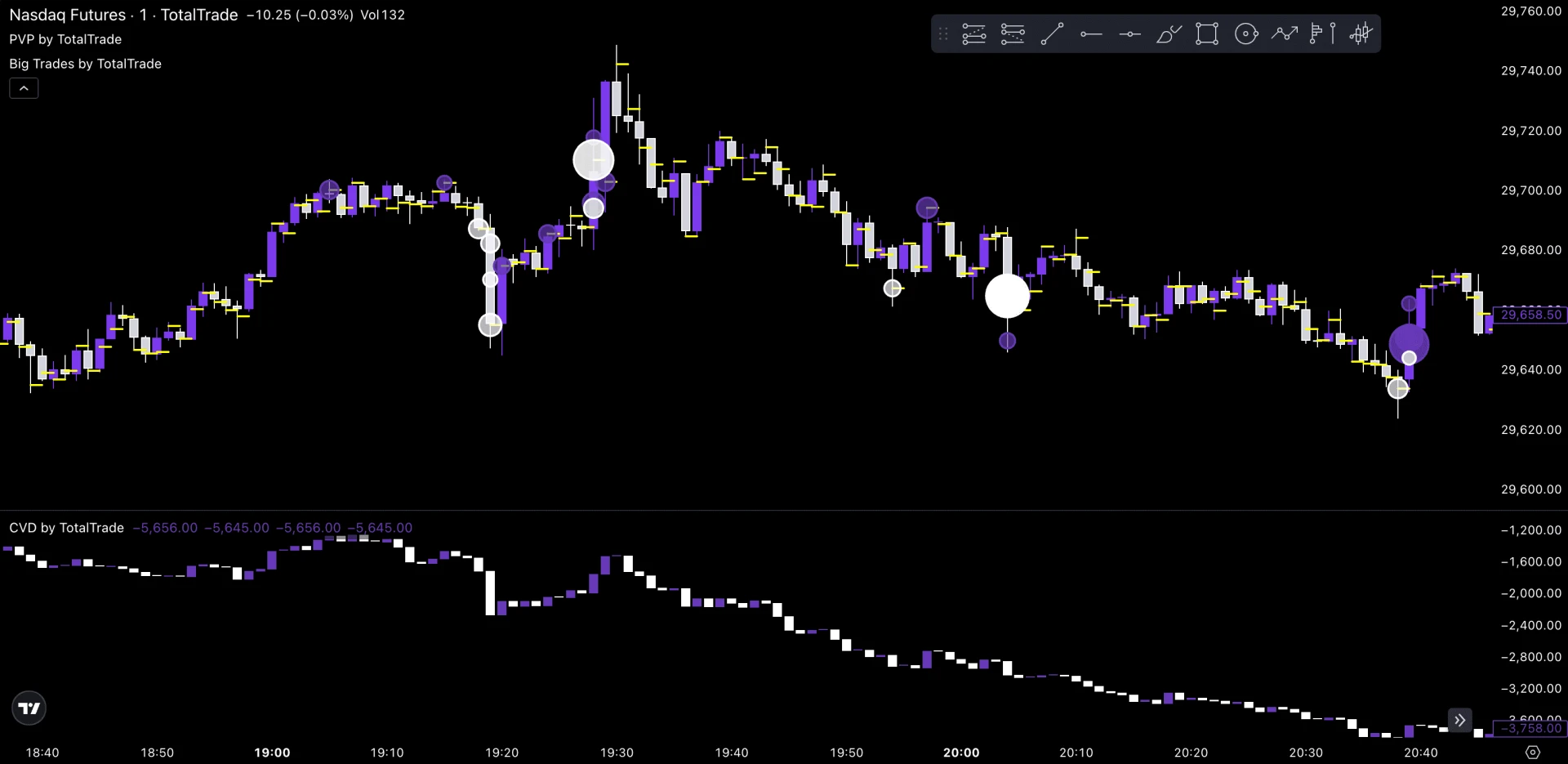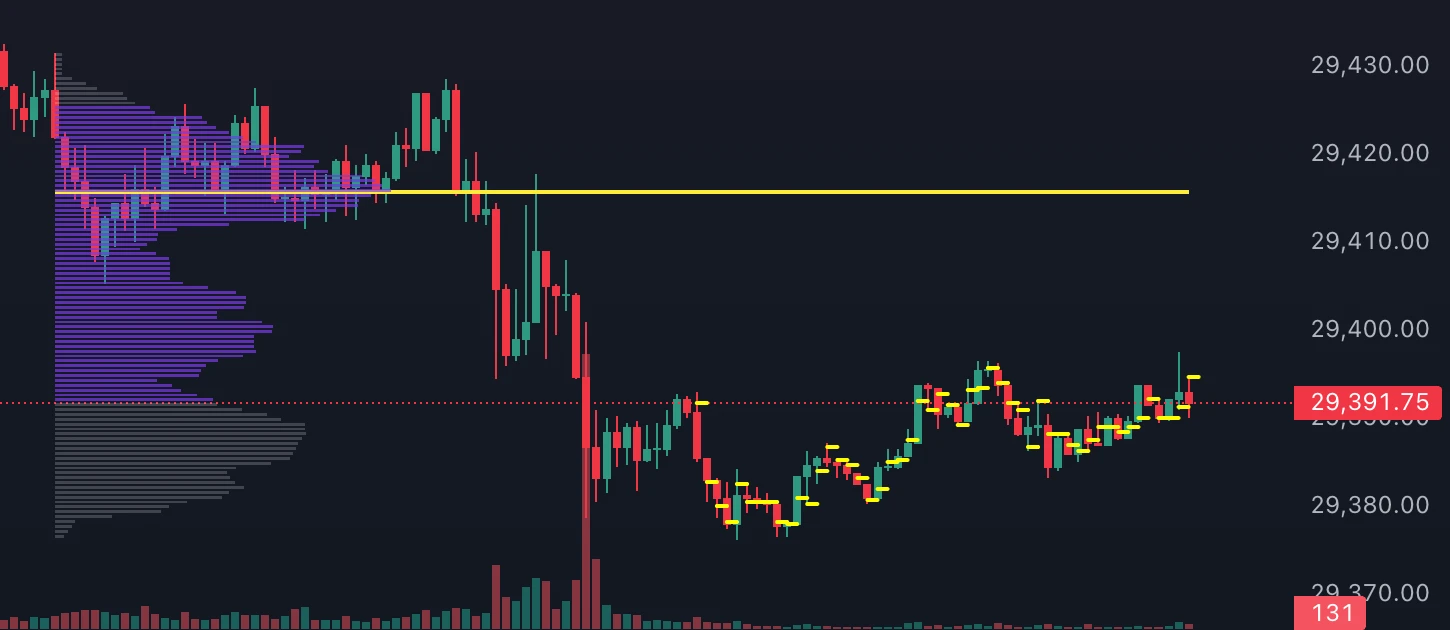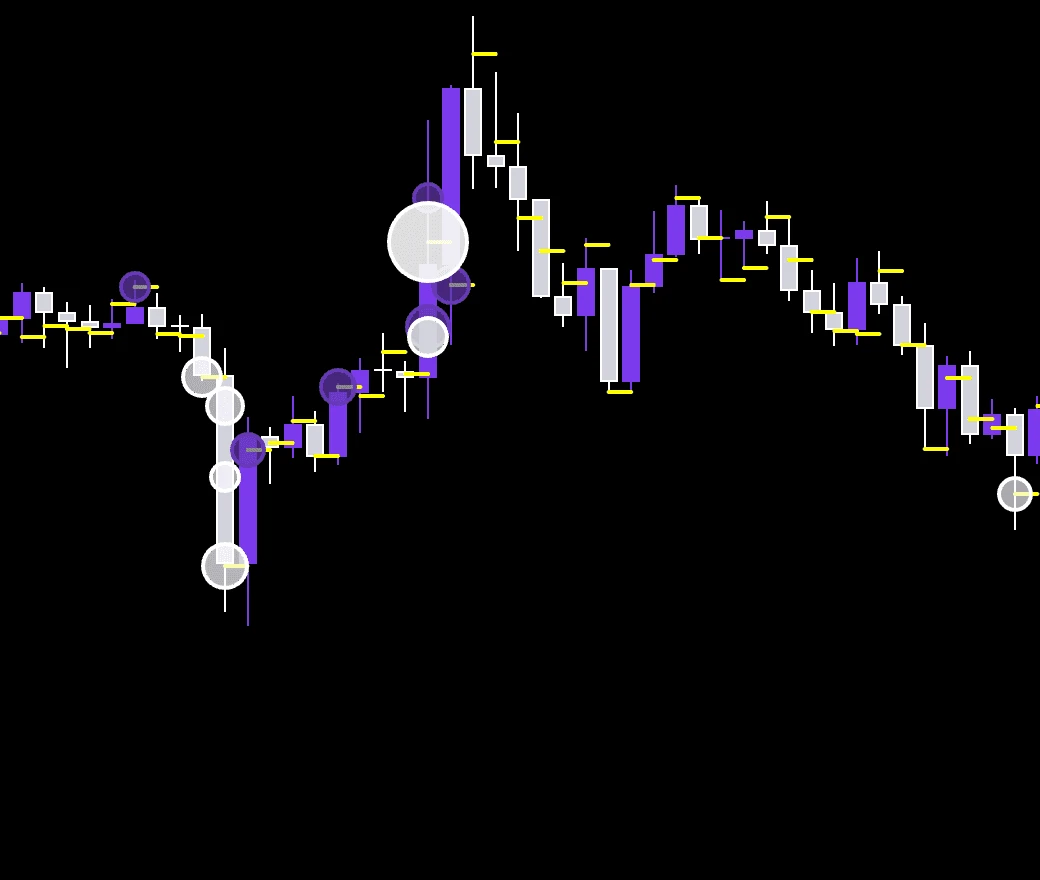
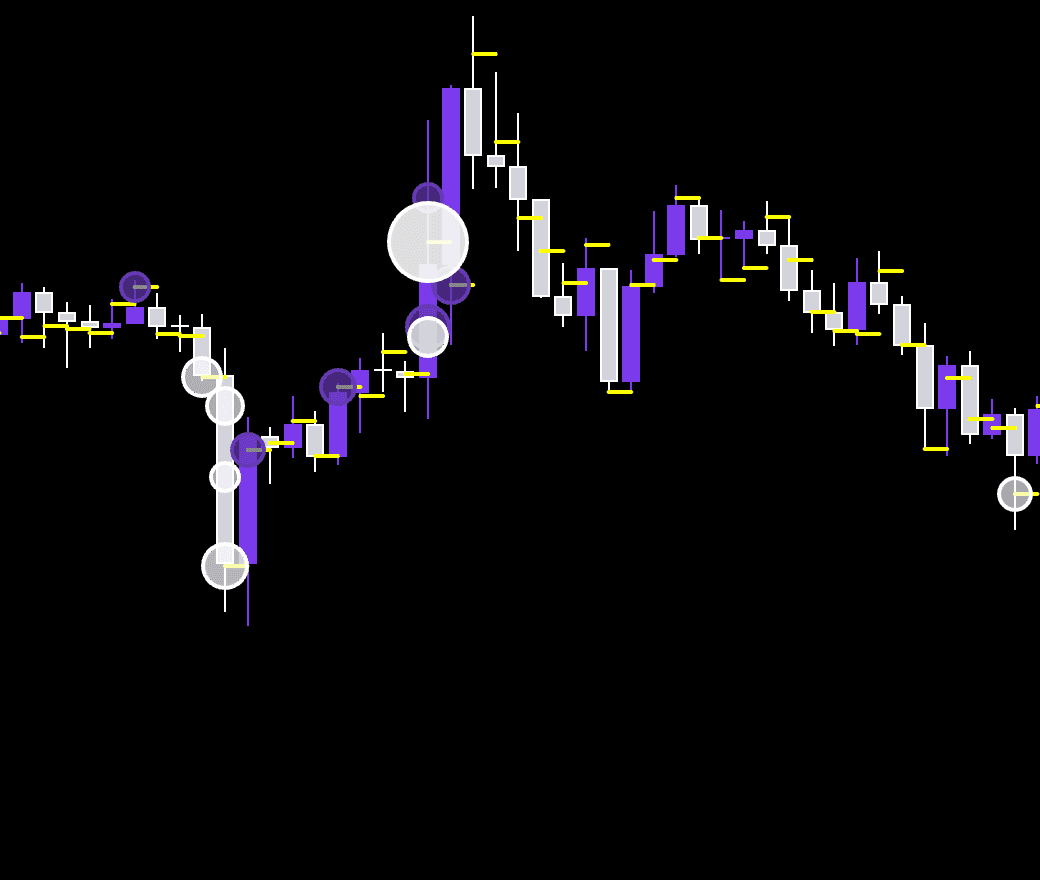
Big Trades highlight unusually large trades on the chart. They show where that volume clustered and let you watch its effect on price. The size of the marker grabs attention, but its meaning depends on context. A large buy that drives a breakout and one absorbed at resistance can lead to opposite outcomes.
What a Big Trade represents
- It's executed activity, not a resting order in the book. The trade already happened at that price.
- It may be a single fill or an aggregate. Some tools select individual transactions; others merge several executions by time or price. A large circle can therefore be one trade or a group.
- It doesn't say who traded. An order can be split into pieces and meet several counterparties. Volume can't be traced back to a specific bank or fund.
- There's always a counterparty. An aggressive buy consumes sell-side liquidity; it doesn't mean sellers were missing. The passive side is what made the trade possible.
Thresholds and aggregation: what you see and what you don't
"Big" depends on the market and your settings. A size that's routine on a very liquid contract can be rare on another, so the same threshold doesn't select equivalent activity everywhere.
An example with a 50-contract filter on individual fills:
| Activity | Total contracts | Shown as a Big Trade? |
|---|---|---|
| 1 fill of 80 | 80 | Yes |
| 20 fills of 5 | 100 | No |
A total volume indicator records both; Big Trades only the first. So:
- no markers doesn't mean no trading;
- raising the threshold reduces what you see, but doesn't automatically make what remains more meaningful.
Before interpreting the chart, check whether the indicator uses individual or aggregated fills and how it expresses size.
How price reacts after a large trade
A large execution means something relative to a level and to what happens next:
- Breakout with follow-through. Large buys hit the high and subsequent trades keep printing higher.
- Absorption. Large buys arrive but price doesn't advance: sell-side liquidity is absorbing them. Watch the next attempts. Resistance can hold, or give way once that liquidity runs out.
- Trend. Large trades in the direction of the move can accompany continuation. But timing matters: during the build-up of an impulse and after a long extension are very different contexts.
CVD tracks delta across the whole stretch; Big Trades highlight only the events your filter selects. Same underlying data, different perspectives. For the bigger picture, see our guide to order flow trading.
Studying them without chasing markers
In replay you can see how large trades show up on your usual setups, for example on a return to a prior high. The indicator can influence your decision to wait, enter or manage, but not every marker needs to become a trade.
During review, ask three questions:
- Did the trade arrive before the acceleration, or after most of the move?
- Did you change your management after seeing it?
- Did the level hold or give way?
Also review cases where the marker was followed by a weak or opposite reaction. Relying only on the most obvious examples in hindsight builds confidence the data doesn't support.
Big Trade by TotalTrade on futures
Big Trade by TotalTrade is available for futures in the indicator catalog on the Ultra plan. In the Backtester you use it alongside price and the other volume tools: slow the replay near your zone, watch the markers appear and assess any entry with your strategy. In Trade Review you can then reconstruct when the large trade appeared and what you decided, with notes and screenshots.
FAQ
Does a Big Trade mean institutions are buying?
You can't tell. It shows a large quantity traded, not the identity or intent of whoever traded it, and every buy has a counterparty selling.
What threshold should I use?
It depends on the instrument and its liquidity. Start with a value that highlights a handful of events per session and check in replay whether those events matter for your setups.
Do Big Trades work on forex?
Spot forex has no consolidated stream of executions. That's why TotalTrade's indicator is built for futures.
For information and education only, not financial advice. Leveraged trading carries a high risk of loss.