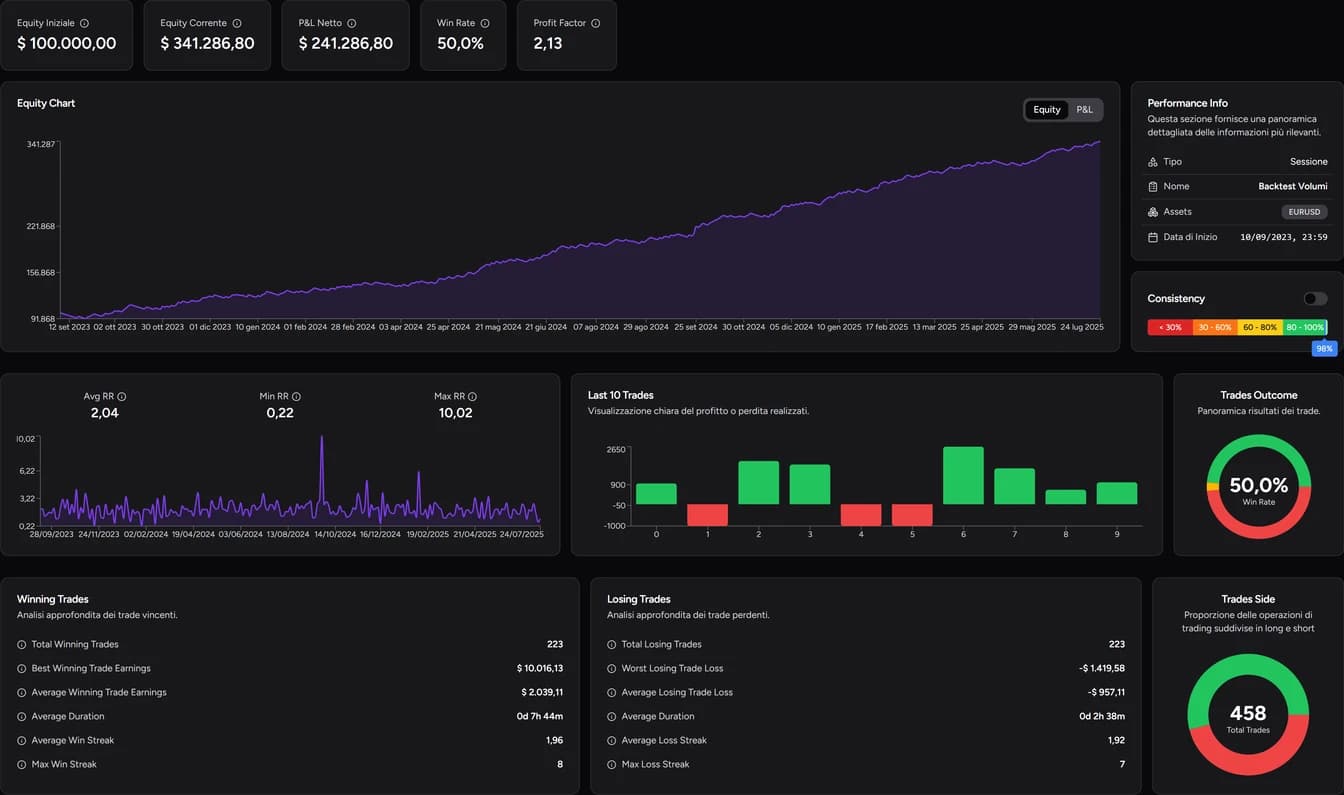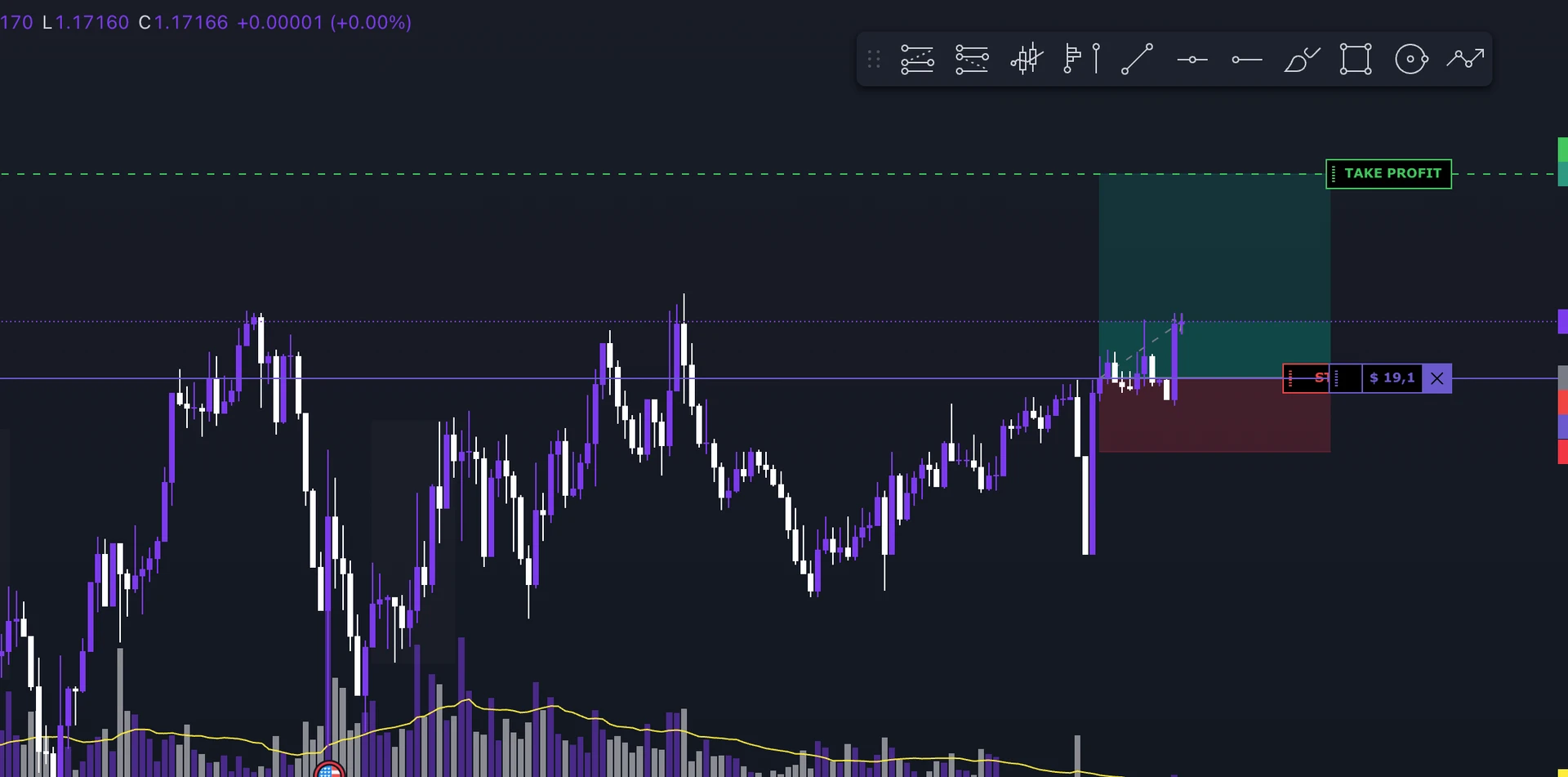
To backtest without coding you need market replay: the historical chart moves forward candle by candle, future candles stay hidden, and you make decisions exactly as you would live, with virtual capital. You don't write rules in code; you apply your own read of price and log every trade for later analysis. It's the right method for discretionary traders, whose decisions an algorithm can't easily reproduce.
Manual backtesting, automated backtesting and forward testing
| Manual backtest (replay) | Automated backtest | Forward test (demo) | |
|---|---|---|---|
| Who decides | You, on the chart | Software, from coded rules | You, in real time |
| Coding required | No | Yes, or a rule builder | No |
| Time | Can be sped up | Seconds or minutes | Market speed |
| Best for | Price action, discretionary management, volume reading | Fully defined rules | Final check before going live |
| Main limitation | Slower than automated; hindsight risk | Misses discretionary judgment | Takes weeks or months |
The three don't compete. Replay lets you study many situations and practice trade management. Forward testing puts you back in the rhythm of the live market. A live account adds the emotional weight of real money, which virtual capital can't reproduce.
Why replay saves time
If your setup appears two or three times a week, collecting 100 trades in a forward test takes months. In replay you fast-forward through quiet stretches and slow down only as price approaches your levels. You work sessions when you have time, not when the market happens to be open.
How a discretionary backtest session works
- Pick the asset and period. Choose a stretch that includes different conditions: trends, ranges and major news.
- Set up the chart as you would live. Same timeframes, levels and indicators.
- Move price forward. Fast when you're not looking for entries, slow near your zones.
- Decide using only what's visible. If you wait for confirmation live, wait for it here.
- Manage the trade to the end. Stops, targets, partials and moving to break even all follow your method.
- Record the reason behind every decision. Entry, adjustments and exit, with a screenshot.
Stops and targets can vary from trade to trade if your method places them on price structure. Scaling out or exiting early can depend on how the move develops. Replay lets you test exactly that part of your trading.
The mistake to avoid: hindsight
Replaying the same stretch of chart helps you understand a mistake or try a different approach. But the second time, you already know what happens. Keep the two passes separate: the first measures how you apply the strategy; the second is study.
The same goes when your strategy is still evolving. Backtesting is a good place to experiment, but when you change a rule, flag it in your notes or start a new session. Mixing trades managed in different ways makes the results impossible to interpret.
What to analyze afterwards
The total result is only the starting point. Look at:
- average win and average loss, to see how the result was built;
- drawdown, to see how hard the ride was;
- the distribution of results, to see whether profit depends on a handful of trades.
You may find you had plenty of good entries but often closed before the target, or that almost all the profit came from two trades you let run. You only see this by comparing statistics with charts and notes, not by looking at the final balance. Our guide to win rate, profit factor and drawdown explains how to read these metrics.
Account for costs and execution too. Spreads, commissions and slippage change results, especially with tight stops or small targets, and a simulation won't necessarily reproduce every condition of your broker.
Backtesting with replay in TotalTrade
In the TotalTrade Backtester you trade the historical chart and manage positions directly on it:
- Bar Replay down to one-second steps, where the data allows;
- orders with risk in percent, cash or volume, plus partials and automatic break-even;
- notes and screenshots on every trade;
- Analytics and Trade Review to revisit individual trades;
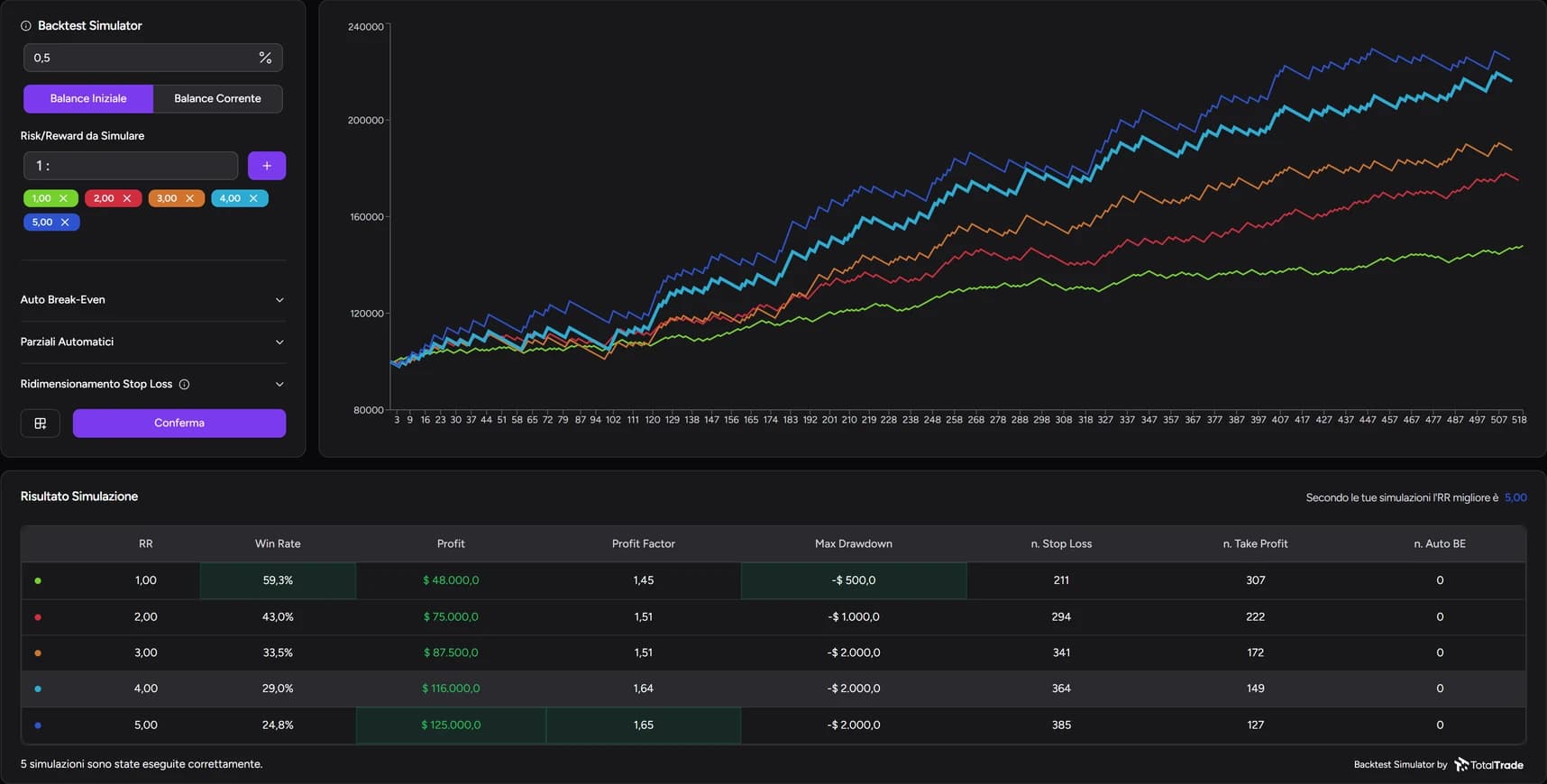
- the Backtest Simulator to recalculate a session with different targets and management rules.
The Backtester tutorial walks through every control step by step. The Free plan lets you try one session lasting one month.
FAQ
How many trades make a backtest meaningful?
There's no universal threshold, but with only a few dozen trades the results shift noticeably with each new one. The more your result depends on a few large winners, the more trades you need to judge it.
Is manual backtesting as reliable as automated testing?
It measures something different: how you apply the strategy, discretionary decisions included. The main risk is hindsight bias, which you reduce by never scrolling ahead and by writing down each decision before you see the outcome.
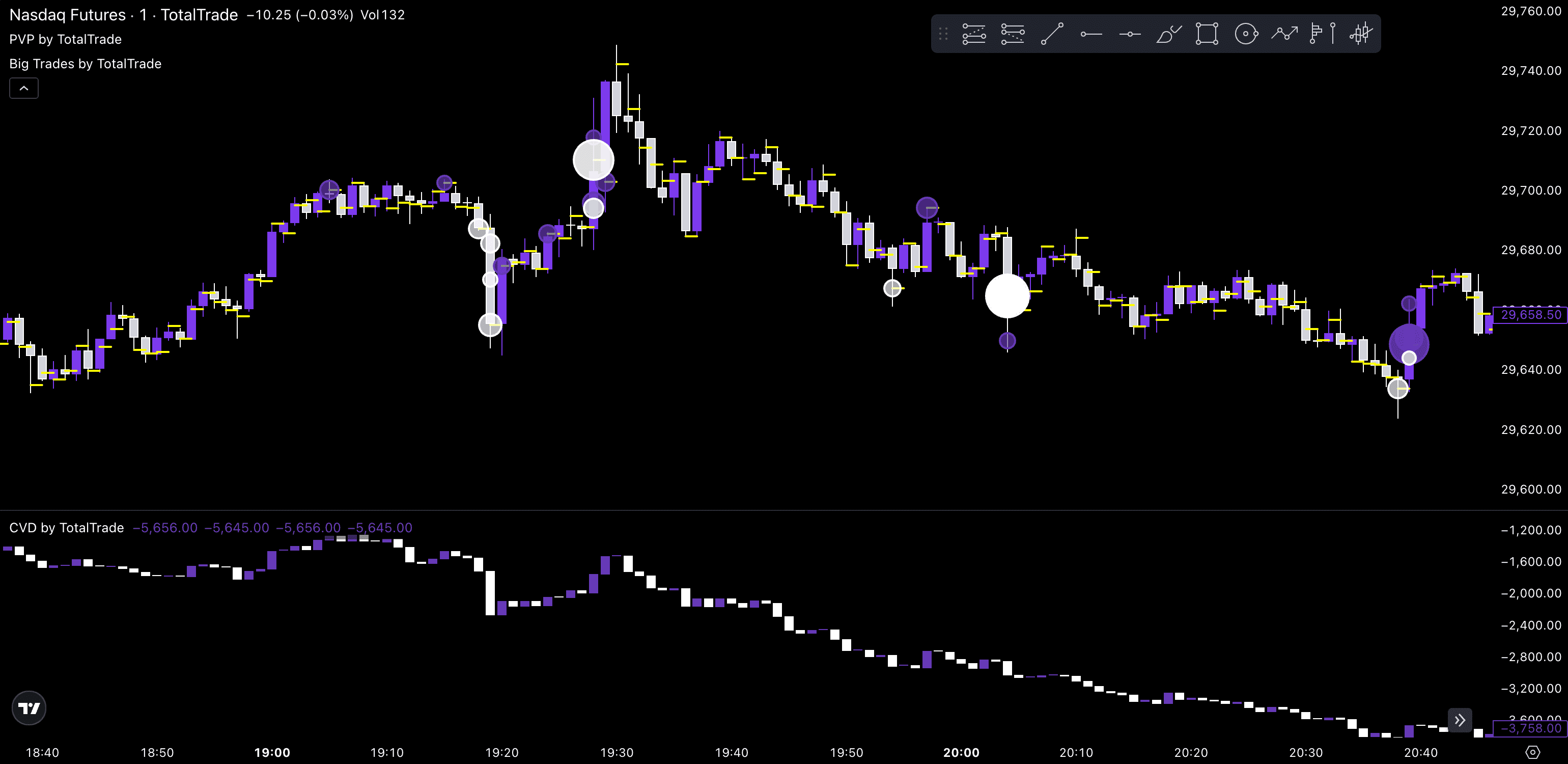
Can I backtest with volume and order flow?
Yes, if the data is available for that instrument. In TotalTrade, the volume indicators CVD, Big Trades and PVP are available on futures with the Ultra plan.
For information and education only, not financial advice. Backtest and simulation results do not guarantee future performance. Leveraged trading carries a high risk of loss.